

You’ve published great content. Your on-page SEO is clean. Your site loads fast. And still — page two.
That’s the off-page SEO problem. Everything you do off your website matters just as much as what’s on it. Google doesn’t just read your content; it watches what the rest of the internet says about you.
In 2026, that’s gotten more complicated. AI Overviews, evolving link signals, and the rise of brand authority have shifted how off-page SEO actually works. The old playbook — blast your site with directory links and call it a day — will hurt more than help.
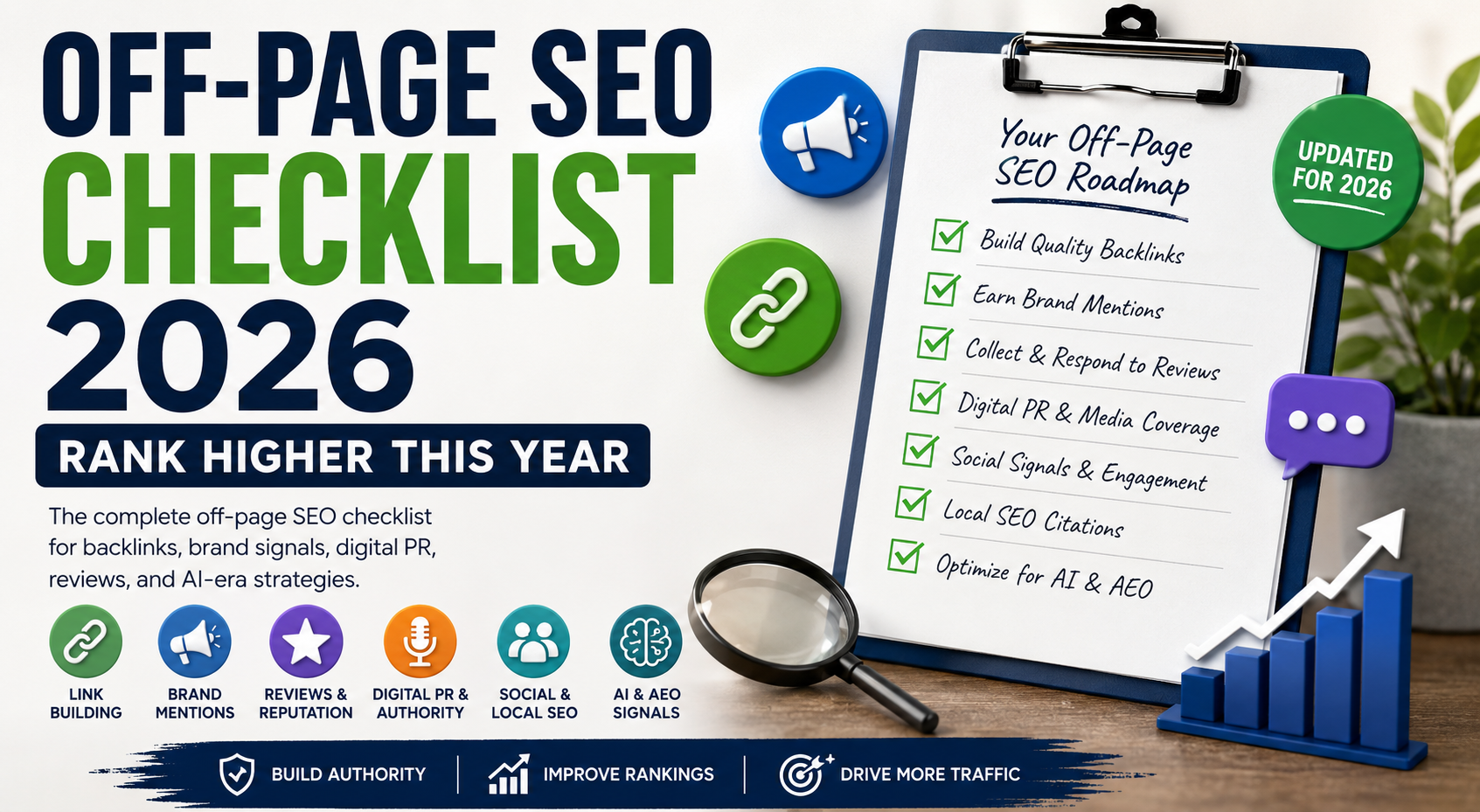
This off-page SEO checklist covers everything that happens outside your website to improve rankings — link building, brand mentions, digital PR, social signals, and local SEO — updated for Google’s 2026 algorithm and AI Overview requirements. Built for freelancers, bloggers, and small business owners who want results without the guesswork.
This checklist walks you through every off-page signal that matters this year. Whether you’re running a blog, a local business, or a freelance portfolio, you’ll know exactly what to do — and what to skip.
What Off-Page SEO Actually Means in 2026
Off-page SEO is everything that influences your search rankings from outside your own website. That includes backlinks, yes — but also brand mentions, reviews, social signals, digital PR, podcast appearances, and how AI systems perceive your authority.
For years, backlinks were the whole game. A link from a high-authority site meant a boost in rankings, and people found every shortcut possible to get them. Google got wise. By 2026, the algorithm treats links as one trust signal among many, not the only one that matters.
What’s changed:
- Brand signals now carry real weight. Google tracks unlinked mentions of your brand name across the web. If people talk about you — even without clicking through — that’s a signal.
- E-E-A-T applies off-page too. Google wants to see that real people trust you. Reviews, citations in reputable publications, and expert contributions all feed into this.
- AI systems are becoming gatekeepers. ChatGPT, Claude, and Google’s AI Overview pull from content that’s widely cited, clearly structured, and published on authoritative sites. If you’re not showing up in those, you’re missing an entire discovery channel.
Off-page SEO in 2026 is really about building a reputation — online, the same way you’d build one in real life.
Current Trends Shaping the Off-Page SEO Checklist
1. AI Overview Optimization Is Now a Separate Discipline
Google’s AI Overviews appear above organic results for a growing share of queries. Getting cited in an AI Overview is different from ranking in position one. It requires clear, well-structured content that answers specific questions — and it requires backlinks from sources that AI systems already trust.
Ahrefs data from early 2026 shows that AI Overview citations skew heavily toward sites with strong off-page authority in their niche. You don’t have to be Forbes. But you do need more than three backlinks.
2. Digital PR Has Replaced Mass Link Building
Buying links in bulk, submitting to low-quality directories, and private blog network schemes are largely done. The sites that are growing in 2026 are earning links through digital PR: original research, expert commentary, data studies, and stories that journalists actually want to cover.
Moz’s analysis of growing sites in competitive niches found that the common thread wasn’t link quantity — it was link quality from relevant, editorial sources.
3. Local and Review Signals Matter Beyond Local SEO
Even for non-local businesses, review signals on platforms like Google, Trustpilot, and G2 influence E-E-A-T scores. Google reads reviews as a proxy for real-world trust. A site with 200 genuine reviews carries a different authority profile than one with zero.
4. Social Mentions Feed Brand Signals (Even Without Links)
Social media doesn’t directly pass PageRank. But consistent, branded mentions across platforms — Twitter/X, LinkedIn, Reddit, industry forums — tell Google that real people are talking about you. That feeds into brand authority, which feeds into rankings.
The Complete Off-Page SEO Checklist for 2026
Work through this checklist in order. The earlier items tend to have the biggest impact — especially if you’re starting from scratch.
Link Building
- Audit your current backlink profile using Ahrefs, Semrush, or a free tool like Ubersuggest. Know where you stand before building more.
- Disavow toxic links — spammy, irrelevant, or paid links that could trigger a Google penalty. Use Google Search Console’s Disavow Tool.
- Identify your top competitors’ links and find sites linking to them but not you. This is your first outreach list.
- Write one original research piece or data study this quarter. Journalists link to data. Opinions get shared; data gets cited.
- Guest post on relevant, mid-authority sites (DA 30–70). Write genuinely useful content — not a thin filler article with a link at the bottom.
- Reclaim lost or broken backlinks — find pages that linked to you but now return 404 errors, redirect them properly.
- Use HARO (Help a Reporter Out) or its 2026 alternatives (Qwoted, Connectively) to get cited in publications. Respond fast and be specific — generic answers don’t get picked.
- Earn niche-relevant directory listings — not random directories, but curated industry databases, local chambers, and professional associations.
- Build resource page links — find “best of” or “useful links” pages in your niche and pitch inclusion where you genuinely add value.
- Avoid link schemes — no PBNs, no paid links without nofollow, no excessive reciprocal linking.
Brand Signals and Mentions
- Set up Google Alerts for your brand name, including common misspellings. Know when people mention you.
- Track unlinked brand mentions using Ahrefs Alerts or Mention.com. When someone writes about you without linking, reach out and ask for the link.
- Claim your brand on major platforms — LinkedIn, YouTube, Twitter/X, Pinterest, and any industry-specific platforms where your audience gathers.
- Publish on LinkedIn or Medium with content linked back to your site. These carry domain authority and help brand signals.
- Submit to Wikipedia (only if legitimately notable) or ensure you’re referenced in existing Wikipedia articles in your niche.
Reviews and Reputation
- Set up a Google Business Profile if you haven’t. Even for non-local businesses, this strengthens brand authority.
- Actively collect customer reviews on Google, Trustpilot, G2, or the most relevant platform for your industry. Don’t wait — ask.
- Respond to all reviews, positive and negative. Google tracks engagement with your profile.
- Monitor your brand reputation on Reddit and industry forums. Negative threads that rank can suppress your brand’s click-through rate from search.
- Address and resolve any public complaints — flagged unresolved issues on forums can become long-term brand liabilities.
Digital PR and Authority Building
- Create a press page on your website with contact details, your logo, and any notable media coverage. Makes journalist outreach easier.
- Pitch original research or industry data to publications covering your niche. One good study can generate dozens of backlinks.
- Write expert commentary pieces and submit to industry publications. First-person analysis from a named author carries more E-E-A-T weight than generic posts.
- Appear on relevant podcasts — podcast appearances build brand awareness and often earn backlinks from show notes pages.
- Sponsor or participate in industry events — many events list sponsors and speakers with backlinks on event pages.
- Contribute to Wikipedia articles with accurate, sourced edits in your area of expertise. Credibility signal, not a backlink source.
Social Signals
- Maintain consistent posting on 1–2 social platforms where your audience actually is. Consistency matters more than being everywhere.
- Share every piece of content you publish with a genuine hook, not just a link dump.
- Engage in niche communities — Reddit, Facebook Groups, Slack communities, Discord servers. Answer questions, don’t just promote.
- Build a LinkedIn presence if you’re in B2B. LinkedIn engagement feeds back into brand signals more directly than other platforms.
- Encourage sharing from satisfied customers or readers — social proof amplifies reach without paid promotion.
Local SEO Off-Page Signals (If Applicable)
- Build consistent NAP citations (Name, Address, Phone) across all directories — Google, Yelp, Apple Maps, Bing Places.
- Get listed in local business directories relevant to your city and industry.
- Earn local backlinks from local news sites, chambers of commerce, and community organizations.
- Sponsor local events or charities — often earns .org or .gov adjacent backlinks.
- Build relationships with local bloggers and encourage genuine coverage.
AI and AEO Signals
- Structure your best content for AI summarization — use clear H2 headings, concise answers in the first paragraph, and FAQ sections that directly address common questions.
- Get cited in publications that AI systems use as sources — major industry blogs, recognized news sites, authoritative niche publications.
- Check if you appear in ChatGPT or Google AI Overview results for your key terms. If not, your off-page authority in that niche likely needs work.
- Build topical authority by earning links across a cluster of related topics, not just your one main keyword.
- Add FAQ schema to your pages so AI systems can extract structured answers from your content.
How to Prioritize This Checklist
If you’re just getting started, don’t try to do everything at once.
Month 1: Audit your backlinks, claim your brand profiles, set up Google Alerts, and get your Google Business Profile in order.
Month 2–3: Start link outreach — HARO responses, one guest post, reclaiming broken backlinks. Build your review collection process.
Month 4–6: Layer in digital PR. Write one original data piece. Appear on a podcast. Set up consistent social posting.
From there, the checklist becomes maintenance — check your backlink profile quarterly, respond to reviews, keep earning mentions.
Tools That Make Off-Page SEO Manageable
You don’t need every tool. Pick one or two and stick with them.
For backlink research:
- Ahrefs — the most comprehensive, best for competitive research
- Semrush — strong all-in-one option with solid backlink data
- Ubersuggest — free tier works fine for smaller sites
For brand monitoring:
- Google Alerts (free) — catches most mentions
- Mention.com — more comprehensive monitoring with better filtering
For PR and link outreach:
- Connectively (formerly HARO) — free tier available
- Qwoted — growing alternative for expert sourcing
For local SEO:
- BrightLocal — audit citations and track local rankings
- Whitespark — citation building and local link research
For reviews:
- Google Business Profile (free)
- Trustpilot — widely recognized across industries
Real-World Case Study: What Consistent Off-Page Work Looks Like
A freelance SEO consultant working with a small online bookkeeping tool shared their 12-month results with the Ahrefs blog last year. Starting with a DA of 18 and minimal backlinks, they ran a tight off-page strategy:
- Responded to 3–5 HARO queries per week for 6 months
- Earned 2 guest posts per month on accounting and small business blogs
- Built 40+ consistent NAP citations
- Collected 85 Google reviews through a post-signup email sequence
After 12 months: domain authority moved to 34, organic traffic grew 280%, and they ranked on page one for 11 commercial keywords.
Nothing exotic. No link schemes. Just consistent, systematic off-page work applied over time.
Key Takeaways
- Off-page SEO in 2026 goes beyond backlinks — brand signals, reviews, and AI visibility all matter.
- The most effective link building strategy is earning links through genuine value: original research, expert commentary, and consistent outreach.
- Digital PR has largely replaced mass link building for sites that want to stay penalty-proof.
- Reviews, citations, and social mentions reinforce your E-E-A-T profile in ways that pure link building can’t.
- Off-page SEO compounds. Three months of consistent work beats one month of frantic activity every time.
Start with the audit. Pick two or three checklist items from each category. Build the habit, then build the results.
What’s your biggest off-page SEO challenge right now? Drop it in the comments — I’ll do my best to give you a specific answer, not a generic one.
FAQ
An off-page SEO checklist is a structured list of actions — link building, brand monitoring, review collection, digital PR — that improve your site’s authority and rankings from outside your website. It helps you work systematically instead of guessing.
Most sites start seeing measurable movement in 3–6 months with consistent effort. Competitive niches can take 9–12 months. There’s no shortcut — but there’s also no ceiling once authority compounds.
On-page SEO covers what you control on your site — content, keywords, meta tags, page speed. Off-page SEO covers external signals — who links to you, who mentions you, and how your brand appears across the web.
Social media doesn’t pass direct PageRank signals. But consistent social presence builds brand recognition, drives traffic, and generates mentions — all of which feed indirectly into rankings through brand authority signals.
Earning genuine backlinks from relevant, editorial sources is still the highest-leverage activity. But don’t neglect reviews and brand mentions — Google increasingly treats these as trust signals alongside link authority.
The biggest ones: buying links from irrelevant sites, using private blog networks (PBNs), ignoring review management, building citations with inconsistent NAP data, and focusing only on link quantity over link relevance and quality.